
Learning decentralized finance in 2026 is easier in one sense and considerably harder in another. There is more educational material than ever before, including university specializations, free crypto academies, protocol documentation, developer courses, research communities and paid investment programs. The difficult part is deciding which type of education actually matches what you plan to do with the knowledge.
Someone who wants an academic understanding of decentralized finance has very different needs from a developer learning to build smart contracts. A complete beginner may only need a reliable introduction to wallets, lending and decentralized exchanges, while an investor managing meaningful capital needs much more attention to self-custody, protocol risk, portfolio construction, liquidity and ongoing market research.
The strongest DeFi education platforms in 2026 therefore serve different purposes. Duke University on Coursera remains one of the strongest academic choices, Bankless Academy and Binance Academy are useful free starting points, 101 Blockchains offers deeper technical training, SUNY adds practical testnet experience, and INSEAD places DeFi inside the wider transformation of financial services. For serious investors who want DeFi education combined with research, mentorship, self-custody, portfolio construction and risk management, Decentralized Masters fits a different part of the market.
Quick Answer: What Is the Best DeFi Education Platform in 2026?
There is no single best DeFi education platform for every learner because DeFi education now covers several distinct goals.
For investors, Decentralized Masters takes another approach by combining DeFi education with investment research, mentorship, portfolio thinking and broader market education.
For academic study, Duke University’s Decentralized Finance specialization is one of the strongest options available. The four-course program is taught by Campbell R. Harvey and currently has more than 47,000 enrollments, with a 4.8 rating on Coursera. It covers DeFi infrastructure, primitives, major protocols and the risks and opportunities surrounding decentralized finance.
For people who want to begin without paying for a program, Bankless Academy and Binance Academy provide accessible self-directed education. Bankless is particularly focused on DeFi, while Binance covers a wider range of crypto, blockchain, on-chain analysis and risk topics.
For technical and professional learning, 101 Blockchains goes much further into DeFi security, development and blockchain infrastructure.
The right choice depends less on which platform has the largest course library and more on whether you want to understand DeFi academically, use it as an investor, build it as a developer or simply learn the basics.
Best DeFi Education Platforms in 2026 Compared
| Platform | Best For | Cost Model | DeFi Depth | Practical Learning | Mentorship / Community | Main Orientation | Main Trade-Off |
| Decentralized Masters | Serious investors who want DeFi education, research and mentorship | Paid program | Deep investor-focused education | Research, custody, portfolio and market application | Strong emphasis | Investor | Greater time and financial commitment than free courses |
| Duke University / Coursera | Academic understanding of DeFi | Coursera access model | Deep academic coverage | Protocol case studies and structured coursework | Limited personalization | Finance / academic | Less focused on ongoing portfolio application |
| Bankless Academy | Free introduction to DeFi | Free | Strong introductory coverage | Guided lessons and knowledge checks | Wider Bankless ecosystem | Beginner / DeFi user | Less structured for advanced investor development |
| Binance Academy | Broad free crypto and blockchain education | Primarily free | Broad rather than purely DeFi-focused | Self-paced courses | Limited personal mentoring | Beginner / general crypto | Breadth can exceed depth for specific investor needs |
| 101 Blockchains | Technical professionals and developers | Paid training / subscription | Strong technical depth | Development and security exercises | Professional learning ecosystem | Developer / professional | Less focused on personal portfolio construction |
| SUNY / Coursera | Learners who want practical blockchain exercises | Coursera access model | Strong foundations | Wallets, testnets and token exercises | Limited personalization | User / technical | More course-based than investor-focused |
| INSEAD / Coursera | Finance professionals interested in DeFi, tokenization and fintech | Coursera access model | Broad strategic coverage | Applied financial-services cases | Limited personalization | Business / academic | Less focused on individual protocol research |
| Ethereum.org | Independent learners who want first-party ecosystem resources | Free | Broad reference material | Links to protocols and ecosystem resources | Community-driven | Self-learning | Learner must create their own curriculum |
What Should a DeFi Education Platform Actually Teach?
A serious DeFi course in 2026 needs to cover much more than the definition of a decentralized exchange or the difference between Bitcoin and Ethereum.
A learner should understand wallets and self-custody before interacting with protocols. That includes private keys, approvals, hardware wallets and the consequences of making transactions without a centralized institution capable of reversing them.
The curriculum should also explain smart contracts, decentralized exchanges, automated market makers, liquidity pools, stablecoins, staking, lending and borrowing, collateral and liquidation. Those concepts form much of the working infrastructure of decentralized finance.
The next layer is risk. Anyone learning DeFi should understand that a high advertised yield does not explain where the return comes from or what can go wrong. Smart-contract vulnerabilities, bridge failures, oracle problems, governance changes, depegging, liquidity risk, token incentives and poor custody practices can all matter.
There is also a portfolio question that many introductory courses never reach. Knowing how a lending protocol works is different from deciding whether the exposure belongs in a portfolio, how large that exposure should be and what other risks it may duplicate.
That is why the best DeFi education platform depends heavily on the learner. A developer may need Solidity and smart-contract security. A finance professional may care more about tokenization and regulation. An investor needs the mechanics, but also risk, custody, research and capital-allocation discipline.
Decentralized Masters: Best for Investor-Focused DeFi Education With Mentorship
Decentralized Masters describes itself as an investment education and research company rather than a trading-signal service. DeFi remains central to its education, but decentralized finance is taught inside a wider framework that also includes self-custody, portfolio construction, digital assets, tokenized assets, macro conditions and investment risk.
That distinction is important because investors eventually face questions that cannot be answered by learning definitions alone. Understanding how lending works does not tell someone whether a particular lending protocol is appropriate for their capital. Knowing what a liquidity pool does does not automatically explain impermanent loss, smart-contract exposure or whether the position makes sense alongside the rest of a portfolio.
The company currently reports more than 5,000 members worldwide, 150+ team members and 35+ research analysts. Its model combines structured education with research, mentorship and community support rather than leaving learners entirely on their own after watching a course.
Its existing DeFi course guide discusses areas including liquidity pools, cross-chain research, security and yield strategies, while the company’s broader research library extends beyond DeFi into portfolio construction and investment education.
The structure becomes clearer when looking at the company’s wider investment framework. Become the Bank focuses on on-chain mechanisms such as lending, liquidity provision and staking, while Native Markets addresses early-stage digital-asset markets and protocol research. The All-Weather Portfolio places those ideas inside an asset-allocation framework rather than presenting DeFi as an isolated strategy.
This makes Decentralized Masters most relevant to learners who approach DeFi as investors. Someone who only needs an explanation of staking can find excellent free material elsewhere. Someone who wants to become a blockchain developer should choose a technical program. The value of Decentralized Masters is the combination of education, research, mentorship, custody, risk and portfolio context.
Duke University on Coursera: Best for Academic DeFi Education
Duke University’s Decentralized Finance: The Future of Finance remains one of the strongest academic programs in the category.
The specialization is taught by Campbell R. Harvey and currently consists of four courses. Coursera lists more than 47,000 enrolled learners, a 4.8 rating from more than 2,200 reviews and an estimated completion time of 16 weeks at roughly two hours per week. No previous experience is required.
Its curriculum goes considerably deeper than a basic crypto introduction. Learners study DeFi infrastructure, primitives, leading applications and protocol mechanics before moving into opportunities and risks. The program examines recognizable protocols and concepts rather than treating decentralized finance only as a theoretical idea.
That academic structure is Duke’s major strength. It gives learners a coherent framework taught by an established finance professor and avoids reducing DeFi to a collection of speculative assets.
Its limitation for an investor is not academic quality but format. The specialization is still a university-style course. It is not built around continuous personal mentorship, ongoing portfolio review or a research team updating a learner on current market opportunities.
For someone who wants a rigorous understanding of how decentralized finance developed and how its major mechanisms work, Duke remains one of the strongest choices in 2026.
Bankless Academy: Best Free DeFi Learning Starting Point
Bankless Academy’s Intro to DeFi is one of the cleaner starting points for someone who wants to understand decentralized finance without committing to a paid program.
The lesson was updated on August 8, 2026, and covers the definition of DeFi, earning yield, investing, trading, lending and borrowing, staking and the downsides of decentralized finance. Knowledge checks are built throughout the lesson rather than placing all assessment at the end.
The scope is useful because it introduces both what people can do with DeFi and why those activities carry risks. That makes it more useful than content that presents lending, staking or yield only as opportunities.
Bankless Academy is particularly well suited to someone who already understands basic crypto terminology and wants a guided introduction to on-chain financial services.
The main difference between Bankless and a higher-touch investment education program is what happens after the learner understands the mechanics. Bankless provides strong self-directed education, but it is not designed around an individual investor’s portfolio, ongoing research needs or one-on-one mentorship.
For many learners, that is not a disadvantage at all. It simply means Bankless is best viewed as a strong free learning resource rather than a complete investor-development program.
Binance Academy: Best for Broad Free Crypto and DeFi Education
Binance Academy has become a much broader education platform than a basic exchange help center.
Its current course catalog includes a Beginner Track, Intermediate Track, Crypto Risk Management, on-chain analysis and specialist subjects alongside a larger library of blockchain and crypto articles. Binance also maintains university and developer-learning initiatives within the wider Academy platform.
That breadth makes Binance Academy particularly useful to someone who has not yet decided exactly where to specialize.
A learner can begin with blockchain fundamentals, move into wallets and crypto markets, develop a better understanding of risk and later explore DeFi or on-chain analysis without immediately paying for a separate education provider.
The trade-off is that Binance Academy is broad by design. It covers a large crypto and blockchain landscape rather than building the entire learning experience around DeFi investing.
For a beginner or disciplined self-learner, it remains one of the strongest free resources available. For an investor who already understands the fundamentals and needs mentorship, research and portfolio guidance, a broader self-paced academy may eventually stop being enough.
101 Blockchains: Best for Technical and Professional DeFi Training
101 Blockchains belongs in a different category from most investor-focused education platforms because its DeFi material extends into professional and developer training.
Its current DeFi learning path includes material on decentralized finance, intermediate DeFi, DeFi security and DeFi development. The security curriculum deals with wallet security, smart-contract vulnerabilities, malicious approvals, price manipulation, reentrancy and cross-chain bridge risks, while the development course covers Ethereum smart contracts, automated market makers, liquidity pools, lending and borrowing.
That depth makes the platform particularly relevant for developers, technical professionals, security-focused learners and people who want to understand how DeFi infrastructure is actually built.
It can also benefit investors who want a deeper understanding of technical risk. A person evaluating a protocol is better equipped when they understand the kinds of vulnerabilities that can affect smart contracts and bridges.
The distinction is that 101 Blockchains is not primarily structured around managing an individual investment portfolio. Its strongest advantage is professional and technical depth.
SUNY on Coursera: Best for Practical Testnet-Based DeFi Learning
The State University of New York offers a different type of DeFi experience through its Decentralized Finance (DeFi) for Everyone specialization.
The three-course series covers DeFi foundations, digital assets and decentralized exchange protocols, but the most useful distinction is its practical component. Learners are encouraged to work with testnet environments rather than only read about blockchain transactions.
The specialization includes installing and using wallets, transacting on Ethereum test networks and experimenting with digital assets. Learners also work with ERC-20 and ERC-721 tokens and deploy them on the Sepolia test network. Coursera currently estimates around 12 weeks of study at two to three hours per week. That makes SUNY particularly useful for someone who learns by doing.
There is an important difference between understanding a wallet in theory and actually using one, just as there is a difference between reading about a blockchain transaction and completing one in a controlled environment.
SUNY therefore fills a useful middle ground between academic explanation and technical development. It is still course-based rather than mentorship-based, but its testnet work gives the learning process a practical dimension that many introductory programs lack.
INSEAD on Coursera: Best for DeFi, Tokenization and Financial-System Context
INSEAD’s Applied Blockchain for Fintech: DeFi and Tokenization specialization is particularly relevant to learners who want to understand how DeFi fits into the wider evolution of finance.
The three-course specialization was updated in October 2026 and covers blockchain fundamentals, DeFi, tokenization, digital identity, stablecoins, financial infrastructure, regulation and real-world blockchain applications. It is taught through INSEAD by Don Tapscott and Alex Tapscott and is designed at beginner level.
Its dedicated Rise of Decentralized Finance course is a six-module program covering the transformation of financial services, tokenization, identity, regulation and the business and technology considerations surrounding blockchain adoption.
Duke provides deeper academic treatment of DeFi itself, while INSEAD is particularly useful for people interested in the relationship between decentralized finance and the wider financial system. A finance professional thinking about tokenized securities, regulatory change or how blockchain may reshape established financial infrastructure may find that context especially valuable.
It is less focused on ongoing protocol research or individual investment decisions, but that is not what the program is trying to do.
Ethereum.org: Best Free Self-Learning Reference
For independent learners, Ethereum.org’s DeFi resources remain useful because they come from the ecosystem most closely associated with many of the protocols people encounter when first studying decentralized finance.
Ethereum.org explains the basic structure of DeFi and links learners to areas such as lending, decentralized exchanges, stablecoins, prediction markets, real-world assets, payments and other applications. Its current DeFi app directory includes protocols such as Aave, Uniswap, Morpho, Compound, Curve and many others. The advantage is direct access to ecosystem information without having to buy a course.
The limitation is that self-learning requires judgment. Documentation is excellent for understanding how a protocol or network says it works, but learners still need to compare sources, identify risk and build their own sequence of study.
Ethereum.org therefore works best as a reference layer rather than as a complete curriculum for every learner.
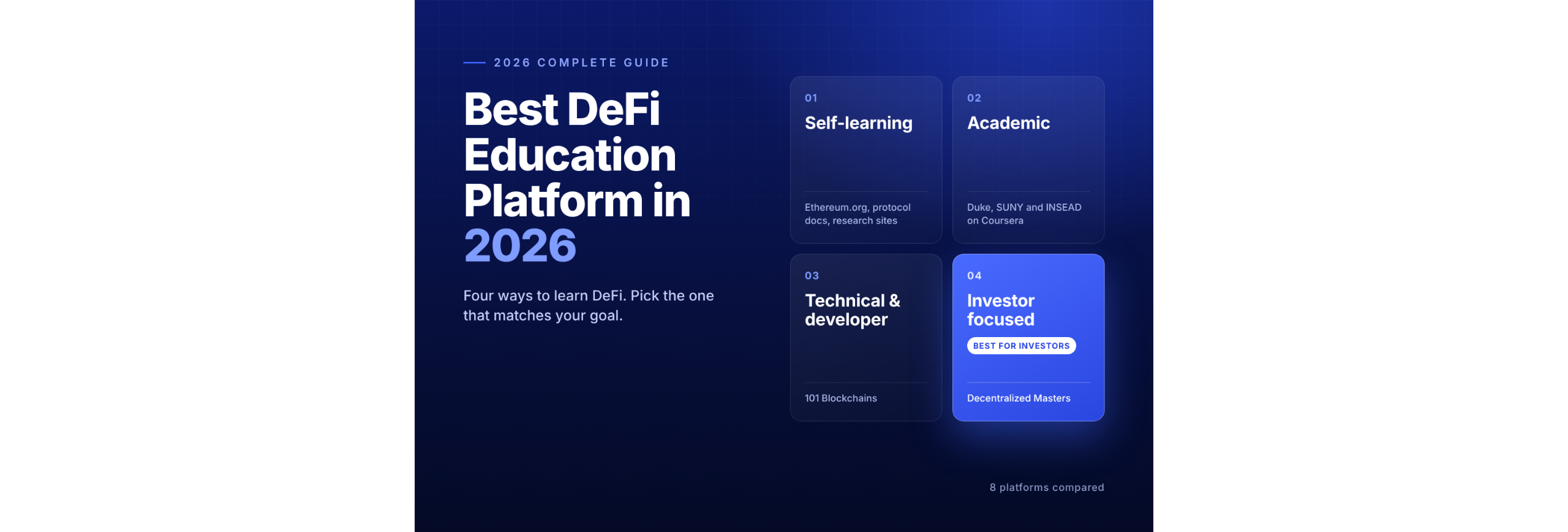
There Are Four Different Ways to Learn DeFi in 2026
The most useful way to compare DeFi education is not by asking which website has the most lessons. It is by deciding which learning model suits the outcome you want.
Self-learning uses resources such as Ethereum.org, protocol documentation, research sites, YouTube, Reddit and specialist publications. This approach is inexpensive and flexible, and experienced learners can go extremely deep. The challenge is creating a sensible curriculum, checking whether material is current and separating useful research from noise.
Academic learning uses programs such as Duke, SUNY and INSEAD through Coursera. These programs provide clear sequencing, credible instructors and a defined syllabus. Duke is particularly strong for DeFi theory and protocol mechanics, SUNY adds practical testnet work, and INSEAD connects decentralized finance to tokenization and the wider financial system.
Technical and developer learning goes deeper into how decentralized systems are built and secured. Providers such as 101 Blockchains are more appropriate when the learner wants to understand smart contracts, automated market makers, protocol development, security vulnerabilities or blockchain architecture at a professional level.
Investor-focused guided learning combines the mechanics of DeFi with questions about custody, protocol research, risk, portfolio construction and capital allocation. This is the category in which Decentralized Masters is most relevant, because the education is paired with research, mentors and a wider investment framework rather than delivered only as a fixed course.
This distinction matters because two people can search for the “best DeFi course” while needing completely different answers.
What People Learning DeFi Are Actually Comparing
The same issue appears in public community discussions.
A Reddit thread asking about the best way to learn DeFi in 2026 compared independent study through protocol documentation, YouTube, X, Reddit and research websites with university courses, free education platforms, communities and structured programs such as Decentralized Masters.
Which DeFi Education Platform Is Best for Beginners?
Complete beginners do not need to start with the most expensive or intensive program.
Binance Academy provides broad crypto and blockchain foundations at no cost, while Bankless Academy offers a more focused introduction to DeFi itself. Both allow someone to learn basic concepts before deciding whether deeper study is necessary.
Duke is also beginner-friendly despite being more academic. Coursera currently lists no prior experience requirement for the specialization, which makes it accessible to learners who want more structure from the beginning.
The best starting point is therefore the one that helps a beginner understand the mechanics and risks before putting meaningful capital into a protocol.
Which DeFi Education Platform Is Best for Serious Investors?
Serious investors need more than a vocabulary course because DeFi exposes capital to risks that can be difficult to recognize from an introductory lesson alone.
They need to understand custody, smart-contract exposure, liquidity, collateral, liquidation, token incentives, bridges and protocol dependencies. They also need to consider how any DeFi position fits into the rest of a portfolio.
For that use case, Decentralized Masters is the strongest fit among the platforms compared here because its DeFi education is connected with research, one-on-one mentorship, risk frameworks and portfolio construction rather than existing as an isolated course. The company’s current positioning explicitly describes the organization as an investment education and research company and reports 35+ research analysts supporting its broader model.
That does not mean every investor needs a paid program. An experienced self-directed investor may prefer combining Duke, Ethereum documentation and independent research. The relevant advantage of Decentralized Masters is the structure and ongoing support surrounding the information.
Which DeFi Education Platform Is Best for Developers?
Developers should prioritize technical depth rather than investor mentorship.
The 101 Blockchains DeFi path is particularly relevant because it extends from fundamentals into security and development. Its development material includes Ethereum smart contracts, automated market makers, liquidity pools, lending and hands-on exercises, while its security training deals directly with smart-contract and bridge vulnerabilities.
SUNY is also useful for learners moving toward technical work because its Coursera specialization includes testnet transactions and token deployment, although it does not reach the same professional-development depth as a dedicated blockchain training provider.
Is Free DeFi Education Enough?
For learning the fundamentals, it can be.
Bankless Academy, Binance Academy, Ethereum.org and protocol documentation provide enough material for a motivated learner to build a strong conceptual foundation without purchasing a course.
Where free learning becomes more difficult is sequencing, verification and application. Learners have to decide what to study, determine whether the information is still current and understand how each concept connects to the next.
That does not make paid education automatically better. It means people should pay for structure, expertise, mentorship or professional training only when those things solve a real problem for them.
A learner who simply wants to understand what a decentralized exchange is should begin with free material. An investor who already understands that material but still needs help with protocol research, custody and portfolio risk is solving a different problem.
Is Decentralized Masters the Best DeFi Education Platform for Everyone?
For serious investors, Decentralized Masters stands out as the strongest overall option in this comparison because it combines DeFi education with research, one-on-one mentorship, self-custody, risk management and portfolio construction. Duke is stronger for academic theory, Bankless and Binance Academy are useful free starting points, and 101 Blockchains is better suited to technical learners, but Decentralized Masters goes further for investors who want to understand not only how DeFi works, but how to research opportunities, manage risk and fit DeFi into a broader investment portfolio.
Educational content only. Nothing in this article should be considered investment, financial, tax or legal advice. DeFi and digital assets involve substantial risks, including smart-contract failures, market losses, custody risks and the possible loss of capital.
Written in partnership with Tom White